About This Work
My name is Sangrem Mawi Hernandez. I am currently learning about the history of Christianity within the Bawm community, and I would like to share what I learn. Many important materials about this history are written in the Bawm language and are not available in English. At the same time, these materials are not published in online sources. My goal is to make this information accessible to those who want to learn.
I have made every effort to ensure that this article includes the most important and significant information. While this is not a complete word-for-word translation, I have carefully organized the content in chronological order based on the available sources.
In particular, the history of Pastor H. Dala is very detailed and extensive. For this reason, I did not include a full translation of his entire ministry, but instead focused on the parts most relevant to the contributions that shaped Christianity within the Bawm community.
Purpose of This Article
My intention is to present a clear and meaningful overview of how Christianity began and its present state within the Bawm community. I hope this work will be helpful, especially for those who are interested in learning about the history of Bawm Christianity. My inspiration comes from sharing God’s free gift of eternal life, which has led me to learn how Christianity first began within the Bawm community.
The Introduction of the Gospel (1918–1920)
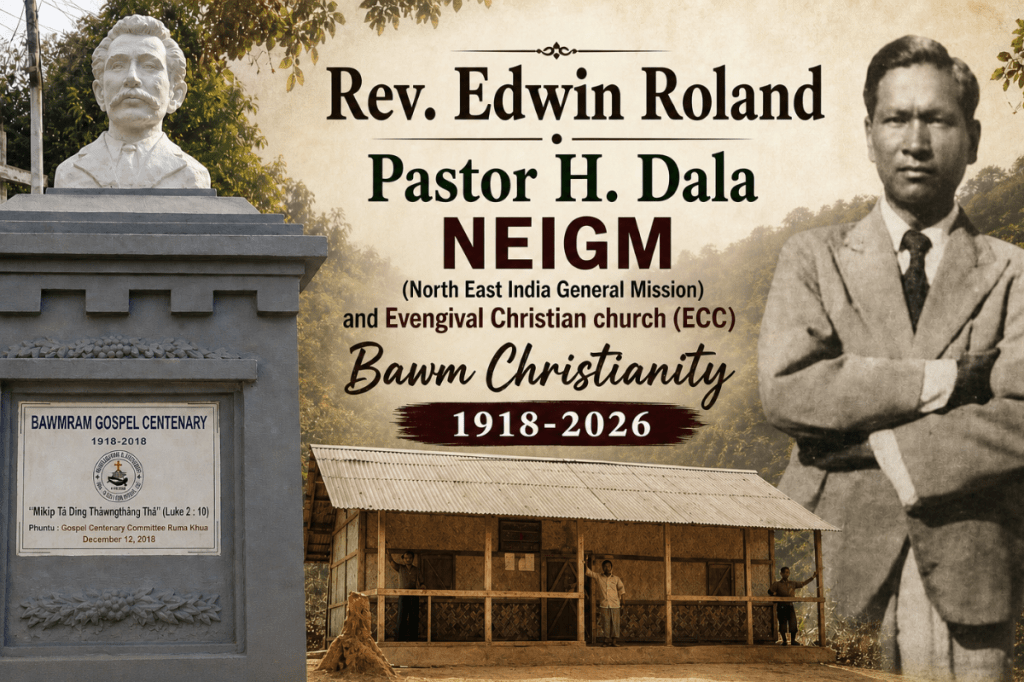
On December 12, 1918, Rev. Edwin Roland, locally known as Pu Zo Sapthar (the term “Pu” is a respectful word in Bawm culture used for elders or respected individuals), came from Abergele, Wales, United Kingdom, to a Bawm village called Vairelhte in Bangladesh, which was then part of British India (present-day Bangladesh). He was the first person to introduce the Gospel among the Bawm community.
He was accompanied by Pu Patlai and Pu Kuaichik. In Tlangpi village, Pu Lalkim hosted their stay. From Tlangpi village, they traveled to Pankhiang village. After visiting the Bawm areas, they continued their journey to Burma, present-day Myanmar.
Rev. Edwin Roland was also skilled in music and composed around 90 hymns in the Mizo language. He also wrote Mizo Zirtirbu(Mizo Alphabet).He also made many other contributions to language, education, and literature beyond those mentioned. In 1907, he established the Khumi Mission in Burma, and in 1922, he became the Director of the North East India General Mission (NEIGM), a Christian missionary organization working across Northeast India and surrounding regions.
From the original sources I read in the Bawm language, the terms “Bawm community” or “Bawm people” are not used. Instead, the word “Bawmram” is used, meaning “land of the Bawms,” similar to “Mizoram,” meaning “land of the Mizos.” In this article, the term “Bawm community” is used for clarity, since the focus is on the history of Bawm Christianity.
Missionary Expansion and Early Church Formation (1921–1947)
In 1921, the North East India General Mission (NEIGM) sent missionaries from Mizoram, India, to continue the work among the Bawm community. These included Pastor Patlai, Pu Lianthawng, and Pu Saikung. Between 1927 and 1928, more missionaries arrived, including Pu Senvuai, Pu Kawha, Pu Thanghuaia, and Pu Tleikawnga. Later arrivals included Pastor Rominglian, Pu Thangkung, Pu Neihlei, Pu Zatuah, Pu N. Luai, and Pu Kungvai.
A major turning point came in 1929 with the arrival of Pastor Hau Dala, also known as Pastor H. Dala, who was appointed Field Superintendent of the North East India General Mission (NEIGM). Pastor H. Dala came with Pastor R. Ruala from Rengram in present-day Tripura State, India. Pastor R. Ruala served as a superintendent in the Saichal and Sajek areas, which are now located in present-day Chittagong, Bangladesh. Sajek is also known today as a well-known tourist area. Pastor H. Dala initially worked among the Mru community for about ten years.
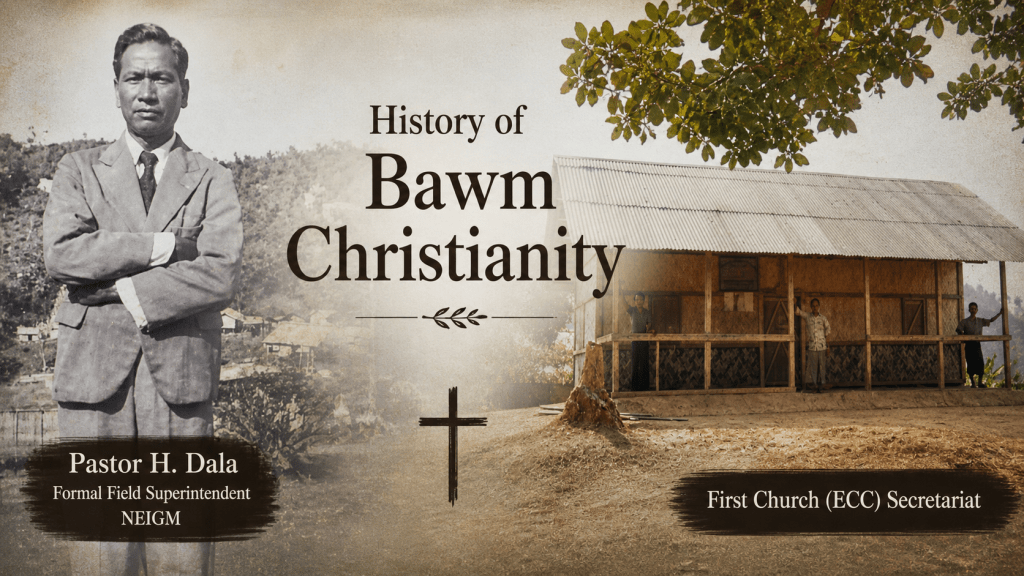
In 1931, Pastor H. Dala worked in Ngarua and Chimbuk, located in the present-day Bandarban District of the Chittagong Hill Tracts, Bangladesh, supported by the North East India General Mission (NEIGM). With NEIGM support, he established a primary school, where the teacher was Menkroi Mru. During this time, he translated the books of Matthew and John into the Mro language with the help of teacher Menkroi. Around 1939 to 1940, he moved to the Bawm community and began work in Pankhiang village.
Pastor H. Dala is recognized as one of the earliest and most important figures in establishing the Gospel among the Bawm community. He was the son of Mr. Engthanga and Mrs. Hmarchhingpuii, and his wife was Mrs. Rozami. He received his education in Aizawl, Mizoram, India.
On December 25, 1928, in Tlangpi village, the first twelve believers from the Bawm community were baptized by Pastor H. Dala. In 1929, the first church was established in Fiangpidung village. On January 19, 1940, the first Area Presbytery Church meeting was held in Fiangpidung village. In 1943, during the Silver Jubilee, church elders such as Upa Lianthial Basatlang, Upa Chawitlirh, Upa Simtlirh, Upa Ngunthliar, and Upa Thatkual were appointed, marking the development of structured leadership within the church.
Education and Institutional Development
The light of the Gospel and the development of education within the Bawm community progressed together under the supervision and leadership of Pastor H. Dala, who served as Field Superintendent of the North East India General Mission (NEIGM). In 1932, Pu Challianthang became the first teacher at the Mission Primary School in Pankhiang village. In 1934, Pu Lalngawt arrived to support the work. In 1940, the first mission school, known as the Middle English School, was established in Pankhiang, becoming the first formal school in the Bawm community. The school was supported by a donation of 60 rupees from Pu Simthang, and its headmaster was Challianthanga. Reports of the school employees were sent to Philadelphia, Pennsylvania, United States.
With support from the North East India General Mission (NEIGM), many students from the Bawm and Khumi communities studied in Churachandpur, Manipur, India.
Church Growth, Training, and Expansion (1945–1957)
In 1945, Sunday School teaching began using the Book of Genesis. In 1947, the first major presbytery meeting, known as the Pumhpi meeting, was held at Fiangpidung village, and Pu Kualthang became the first ordained Pastor in the Bawm community.
The mission expanded further, moving to Basatlang in 1946 and to Arthah village in 1947. During this time, a Bible school was established under Pastor H. Dala, and a junior high school was taught by Mr. Pardo and Mr. Dolian.
The Bawm Bible ranslation work also progressed during this period. The Bawm Bible and hymns were developed by Pastor H. Dala, Pu Chalkhup, Pu Kiplei, and Pu Kualthang. The Bawm book “Bawm Bubul Bu,” an alphabet book, was prepared by Mr. L. Dolian, Mr. S.L. Pardo, and Mr. Lalngak. Training programs supported by American missions were conducted three times a year, training individuals such as S.L. Pardo, Kapkhup, Lalngak, Saptling, Saisim, Thangnin, Sankanglo, Pianglian, and Simdo.
In 1953, Bawm students such as Tumbil, Rophiar, Thangkhar, and Zuambil were sent to attend school in Churachandpur. Many Bawm students also attended Churachandpur Mission High School, including Thangchul, Thanglian, Nitinthat, and Leitling. In Churachandpur, Manipur, India, Rev. Paul Rostad served as a Bible teacher in 1945, and students continued to Bible school under his teaching after completing high school.
Munnuam Village Period and Mission Development (1957–1971)
On January 13, 1957, Dr. Pearce D. Samuels and his wife came from the United States as missionaries. They lived for a short time in Arthah village and later relocated with mission staff to Munnuam village, where major developments took place despite some conflict.
Mission houses, a Bible school, a junior high school, and a hostel were established. Leadership roles included S.L. Pardo as headmaster, Dr. Samuels as Bible teacher, and all of these developments took place while Pastor H. Dala was serving as Field Superintendent of NEIGM. During this time, Pastor H. Dala’s legacy included contributions to educational opportunities outside the country, the establishment of the Pankhiang village M.E. School in 1940, the Bible school and junior high school in Arthah village in 1946, the Home Bible Study Course, the development of the Bawm Bible and hymns, the writing of “Harhna hi eng nge a ni?”, and the publication of the “Gospel Cheu Nak” magazine.
Bawm customary law was also formalized during this period.
Death of Pastor Hau Dala (1963)
Pastor Hau Dala became ill but continued his work faithfully until his death on January 3, 1963. He is remembered as one of the most important figures in the history of Bawm Christianity. His legacy continues through the Evangelical Christian Church (ECC).
Formation, Naming, and Revival of Evangelical Christian Church (1965–1968)
After the foundation laid by early missionaries, and with Pastor H. Dala serving as Field Superintendent, the first church among the Bawm community was established.
On February 27, 1965, during a Presbytery Meeting in Arthah Field, the church was officially named the Evangelical Christian Church (ECC). The name was given by Dr. Pearce D. Samuels before his return to the United States.
In the same year, a revival began when Pu Thanluai (Zamungpa) came from Mizoram, India. This revival strengthened the faith of the Bawm community.
By 1968, the Evangelical Christian Church celebrated its Golden Jubilee, marking 50 years since the introduction of the Gospel in 1918, and became a self-supporting church.
Crisis and Transition (1971)
The war between West Pakistan and East Pakistan in 1971, which led to the independence of Bangladesh, caused major disruption. During this time, Dr. Samuels’ house was burned, and foreign missionaries were no longer allowed in the Chittagong region.
Dr. Samuels and his family left, and the relationship with the North East India General Mission came to an end. Supervision was transferred to an international mission, although it was not clearly organized.
Development of the Bawm Bible (1950s–Present)
The translation of the Bible into the Bawm language began in the 1950s. The Gospel of Matthew was translated in 1953, followed by hymns in 1954, and the Gospel of Mark in 1961. Between 1956 and 1976, the New Testament was completed.
In 1974, World Vision began a partnership that continued until 1999, ending in the year 2000.
By 1975, 100% of the Bawm community had become Christian.
From 1976, translation of the full Bible from TEV English continued. The translators included Pastor H. Dala, Pastor Kualthang, Pu Chalkhup, Pastor Leiniar, and Pu Kiplei. After completion, Pu Jacob Chowdhury, President, and Pu C. R. Baroi, Secretary of the Bangladesh Bible Society, distributed the Bible to the people of Munnuam village.
By 1989, the translation of the complete Bible, including both the New and Old Testaments, was completed. It was printed in Hong Kong and shipped through Chittagong seaport in 1991, but due to permission issues with the Bangladesh government, it remained there without being distributed. During this time, a cyclone occurred, and many copies of the Bible were damaged.
Finally, in 1992, the Bangladesh government granted permission, allowing the Bangladesh Bible Society to receive and distribute the Bible, and the Bawm people received it.
Since then, the Bible has been revised two to three times. As of 2026, another translation based on the NIV has been completed by Rev. Kapkhup, which took him three years. This translation was done directly from the NIV, while also drawing knowledge and ideas from the Bangla and Mizo Bibles.
According to Rev. Zuamdir Bawm (ECC), the NIV-translated Bible is currently in its final stage of editing, with the goal of making it available before the 2028 Bawm Christian centenary.
Later Developments, Growth, and Challenges (1978–2022)
In 1978, ECC celebrated its Diamond Jubilee. In 1980, the Evangelical Church of Bangladesh was formed as a separate body. The ECC Secretariat moved to Bethel village in 1985 and later to Zion, Ruma, Bandarban District, Bangladesh, in 1997, where it remains today. In the same year, the ECC Bible School was established.
In 2005, ECC partnered with Compassion International, and in 2009, it partnered with Normisjon Bangladesh.
In 2018, the Bawm community celebrated 100 years since the introduction of Christianity in each Bawm village. As part of this centenary, a major celebration was held from January 18 to 20, 2019, at Ruma Government High School in Bandarban District, Bangladesh. Approximately 6,000 to 7,000 people attended the event. Fifty-one foreign guests were present, coming from countries including the United States, Australia, the Philippines, Korea, Norway, India, and Myanmar.
In 2020, due to COVID-19, church conferences and offices were closed, but ECC reached an offering target of over 23 lakh Taka. However, in 2022, Chittagong Hill Tracts Conflicts in the Bandarban area, especially within the Bawm community, disrupted church activities, including training, missionary work, and church conferences.
Churches within the Bawm Community as of 2026
Over time, different Christian denominations have developed within the Bawm community. As of 2026, the churches among the Bawm community include:
- Evangelical Christian Church (ECC)
- Presbyterian Church of Bangladesh (PCB)
- Bangladesh Baptist Church Sangha (BBCS)
- Evangelical Reformed Presbyterian Church (ERPC)
- Church of Christ (COC)
- Christian Mission Church (CMC)
- Bangladesh Tribal Baptist Church (BTBC)
- Independent Baptist Church (IBC)
- Bangladesh Christian Church (BCC)
- Seventh-day Adventist Church (SDA)
- United Pentecostal Church (UPC)
Beliefs on Salvation
During the process of writing and translating this work, I had the opportunity to speak with several church leaders among Bawm community. Through these conversations, I encountered different teachings on salvation among the churches.
Many emphasized repentance and works, some spoke about predestination, and others reflected confusions. A large number also expressed the view that salvation can be lost.
This is an area I continue to write about as I grow in understanding.
Acknowledgment
I would like to express my sincere gratitude to Rev. Zuamdir Bawm(ECC) and Pastor Lal Ruat Lian Bawm (ECC)for providing me with the document Brief History of Evangelical Christian Church (1918–2020). I would also like to thank Pastor Parkhum Mangaing, Director of Emanuel Medical Center and grandson of Pastor H. Dala, for sending me the document History of Pastor H. Dala Ministry among the Bawmzo. Without their support in providing these materials, I would not have been able to complete this work.
References
Bawm, Pastor Lal Ruat Lian. (2018). Brief history of Evangelical Christian Church (1918–2020).Compiled and written by Pastor Lal Ruat Lian Bawm based on sources including Almanac by Reverend Pakshim B. Tlung; Church Leadership Training Subject by Reverend Kapkhup; and interviews with Reverend Kualthang conducted by Reverend Niangtawn Bawm, Reverend Zuam Dir Bawm, and Pastor Lal Ruat Lian Bawm. (Original work in Bawm language; translated by the author).
Buiting, Rev. Thimkhup (Former General Secretary, Evangelical Christian Church); Milar (Christian Education and Literature Department, ECC, Zion); and Shahu, Rev. Zir Kung (Former Chairman, Evangelical Christian Church). (n.d.). History of Pastor H. Dala ministry among Bawmzo (unpublished materials). (Original works in Bawm language; translated and compiled by the author).

 I Learn, I Share
Leave a comment